
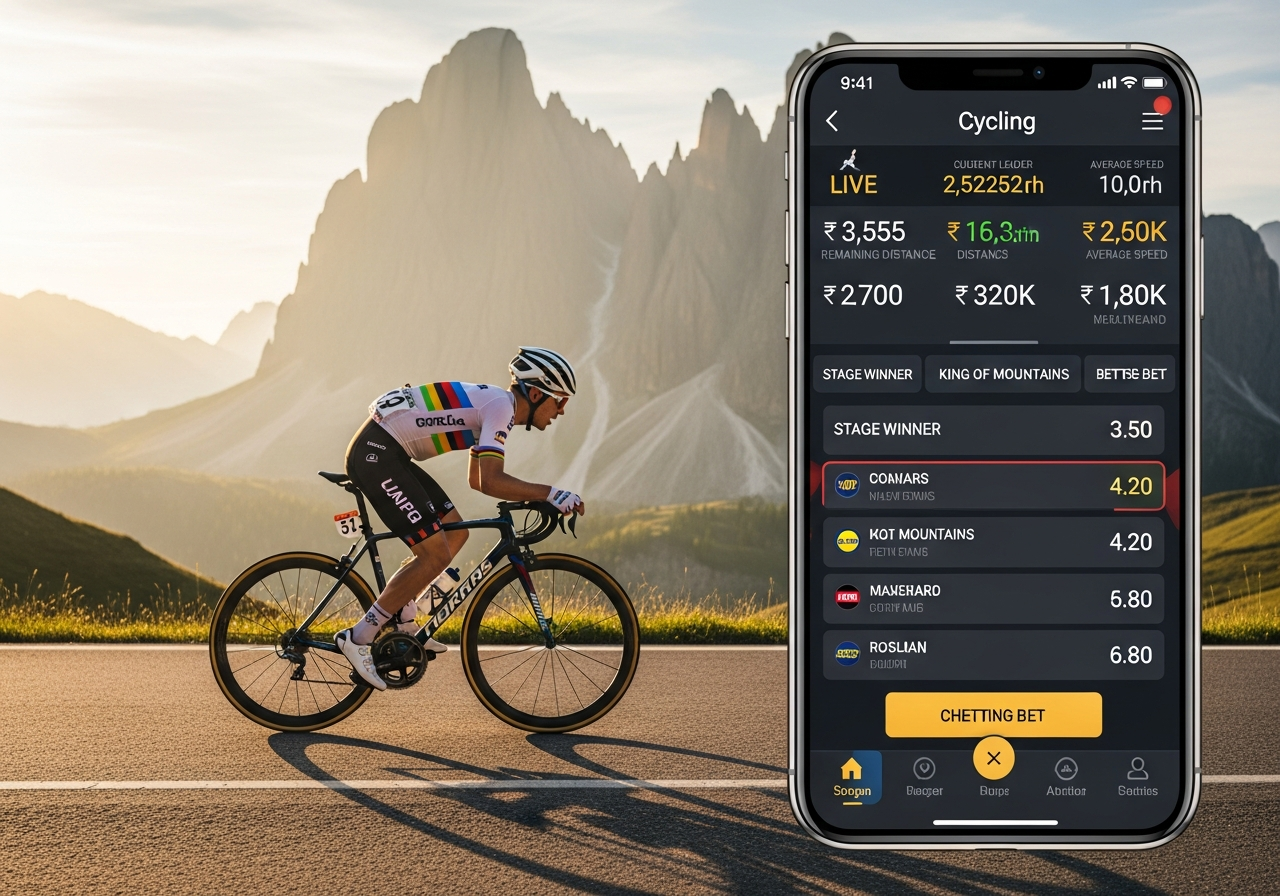
How To Bet On Cycling Events
Cycling has emerged as one of the world’s most captivating sports, with events like the Tour de France, Giro d’Italia, and Vuelta a España drawing millions of viewers and passionate followers from every continent—including India. Beyond elite professional racing, India’s cycling community has grown exponentially, from ultra-distance events like the Race Across India to popular mass-participation rides such as L’Étape Mysuru. This surge in interest has naturally extended to betting, with Indian cycling fans now eager to wager on everything from Grand Tour stages to international classics.
Yet betting on cycling from India presents unique challenges: navigating India’s complex legal framework, finding sportsbooks that accept Indian payment methods, understanding the full spectrum of cycling betting markets, and developing disciplined strategies suited to multi-stage races. This guide is designed specifically for Indian punters, combining practical information about legal compliance, trustworthy operators, market mechanics, and proven bankroll management techniques tailored to the Indian context. Whether you’re new to sports betting or an experienced punter exploring cycling markets, this roadmap will equip you to place informed wagers on the races you love.
Understanding Cycling Betting Basics for Indian Punters
Cycling betting shares many structural principles with other sports betting, but its unique format—featuring stages, classifications, team dynamics, and multiple race types—creates a rich variety of wagering opportunities. Unlike a single-event sport such as tennis or football, Grand Tours unfold over three weeks, offering dozens of daily betting markets alongside longer-term outcome bets. This extended timeline means Indian bettors can engage with cycling markets continuously, from pre-race outrights to in-play stage decisions, making it essential to understand how races work and what betting options are available.
The fundamental concept is straightforward: you predict an outcome (a rider finishing, a stage winner, a classification leader) and receive a payout determined by the odds if your prediction proves correct. Odds are typically displayed in decimal format on international sportsbooks (e.g., 3.50 means a ₹100 bet returns ₹350 total), with settlement occurring immediately after the event concludes. Cycling betting differs from team sports in that outcomes are determined by individual performance within a structured, transparent competition—there are no draws, no injury-time drama, and results are definitive.
Indian bettors should understand that the same race formats and markets available to European punters are accessible through international online sportsbooks. A rider’s performance in the Tour de France on stage 15 affects odds and settlement in exactly the same way whether you’re placing a bet from Mumbai, Delhi, or London. The key advantage of learning cycling betting mechanics is that you’re learning a globally standardised language; once you grasp the markets and odds, you can bet on any cycling event worldwide.
Key Cycling Race Formats: Grand Tours, One-Day Races & Time Trials
Grand Tours—the Tour de France, Giro d’Italia, and Vuelta a España—are three-week stage races where riders compete daily over varying terrain. Each day features a single stage (typically 150–220 km), and cumulative time determines the overall General Classification (GC) winner. Bettors can wager on the overall race winner (an outright at very long odds), individual stage winners (daily markets at shorter odds), and classification jerseys (yellow for GC, green for points, red/white for mountains and youth). Stage races across Asia, Africa, and South America follow similar structures but over shorter durations (typically one to two weeks), offering similar betting markets.
One-day classics—races like the Tour of Flanders, Paris-Roubaix, and Milan-San Remo—are single-stage events held throughout the professional calendar. These races attract specialist tactics and often feature breakaways or surprise winners, making them appealing for bettors seeking variety from stage-race patterns. Betting markets for classics are primarily outright winner bets and occasional props such as top-three finishes. Time trials (individual and team formats) are races against the clock where riders compete individually or in relays on a set course, with finishing times determining rankings. Time trials appear as individual stages within Grand Tours and as standalone championship events, and they offer specific betting angles because performance depends heavily on rider specialisation and course profile.
Core Cycling Betting Markets Explained
Outright winner bets are the simplest and most common cycling wagers. You pick who will win the race (or stage), and if that rider finishes first, you win. Grand Tour outrights carry very long odds (10.00 to 100.00+) because there are 100+ contenders; stage outrights are much shorter (2.00 to 8.00) because the field is effectively smaller. Stage winner markets are offered daily during Grand Tours and multi-day races, allowing you to bet on each stage’s victor independently.
Jersey classification bets allow wagering on secondary outcomes: who will wear the yellow jersey (GC leader), the green points jersey, the red/white mountain jersey, or the white young rider jersey. These often carry moderate odds (3.00 to 15.00) and are popular among bettors who want exposure to races without backing individual stage outcomes.
Head-to-head (H2H) matchups pit two riders against each other; you predict who will finish higher in a specific stage or race. For example, “Rider A vs Rider B in Stage 5” with the market settling on whoever finishes first. H2H markets typically offer odds near 1.90–2.10, making them popular for balanced risk.
Top-finish markets (top three, top 10) offer more flexibility than outrights—a rider need only achieve a certain placing rather than winning outright. These are useful for backing strong contenders you’re confident about but less certain will win.
Props and specials vary by sportsbook but might include stage group predictions (will the breakaway stay away or be caught?), rider-specific outcomes (will Rider X finish the race?), or sprint-timing bets during in-play windows. These add variety and can offer good value for informed bettors.
Legal Landscape: Can You Bet on Cycling From India?
India’s gambling laws are fragmented and complex. The Public Gambling Act of 1867 prohibits many forms of gambling, but states have authority to regulate their own industries. Some states (like Goa and Sikkim) have licensed online gambling operators; others prohibit it entirely. Online sports betting operates in a legal grey zone: there is no explicit federal permission, but no total ban either. Many international sportsbooks accept Indian players, and thousands of Indians legally place bets via these platforms daily.
This guide is informational and does not constitute legal advice. You should verify the current legal status of online betting in your state and jurisdiction before wagering. The responsibility to comply with local law lies entirely with you. That said, Indian bettors commonly use licensed international operators that hold valid gambling licenses in jurisdictions like Malta, Curaçao, or the UK. These sportsbooks are regulated by third parties, offer player protections, and maintain transparent settlement practices. Using an unregulated or offshore-only operator carries significantly higher risk of account freezes, withdrawal delays, or missing funds.
The practical reality is that major international sportsbooks have integrated payment systems (UPI, net banking, e-wallets) that work seamlessly from India, making compliance and safe betting accessible. Many Indian bettors use these platforms regularly without legal incident; however, it is your obligation to understand and follow your state’s regulations.
Licensed Operators, KYC and Safety for Indian Players
A licensed sportsbook undergoes regular audits, must segregate player funds from operational funds, and faces significant penalties if it breaches player protections. For Indian bettors, this means preferring a sportsbook that holds a recognised gaming license (Malta, UK, Curaçao, etc.), implements robust Know-Your-Customer (KYC) verification, and displays clear terms around cycling betting specifically—such as how odds are settled, whether live betting is offered, and how withdrawals are processed.
KYC requirements involve uploading identity documents (PAN, Aadhaar, passport) and proof of address. While this can feel cumbersome, it protects you: only verified accounts can deposit and withdraw, preventing fraud and money laundering while ensuring your winnings are legitimately yours. A sportsbook that does not enforce KYC is a red flag; it suggests lack of regulatory oversight and exposes you to account security risks. Look for operators that explicitly mention sports betting licenses and third-party certifications (such as eCOGRA for fair play) on their website.
Finding Cycling Events to Bet On From India
Cycling has a dense global calendar, with races happening almost every day during peak seasons (spring and summer in Europe, with events year-round in Australia, Asia, and South America). The UCI (Union Cycliste Internationale) maintains a comprehensive calendar, and major sportsbooks offer markets for events ranging from World Tour stage races to smaller UCI continental events. For Indian bettors, the challenge is not finding events but identifying which ones have reliable betting coverage and which offer the best markets.
| Event type | Example race | Typical markets | Relevance for Indian bettors |
|---|---|---|---|
| Grand Tours | Tour de France, Giro d’Italia, Vuelta a España | Stage winner, GC winner, jersey classifications, H2H | Very high; extensive coverage, 3+ weeks of daily markets, world-class field |
| UCI World Tour one-day classics | Tour of Flanders, Paris-Roubaix, Milan-San Remo | Outright winner, top-three finishes, H2H | High; prestigious events, specialist markets, varied terrain and tactics |
| Stage races (multi-day, non-Grand Tour) | Tour of Britain, Vuelta a Burgos, Tour of Belgium | Stage winner, GC winner, classification bets | Moderate to high; shorter duration, interesting breakaway opportunities |
| Time trial championships | UCI Road World Championships ITT, Tour de France ITT stages | Outright winner, H2H, stage-specific bets | Moderate; specialist appeal for TT enthusiasts, useful daily stage markets in Grand Tours |
| Asian UCI events | Tour of Thailand, Tour of Vietnam, Tour of Japan | Stage winner, GC winner | Moderate; emerging markets, growing coverage, some events may have limited betting depth |
| Indian cycling events | Race Across India, L’Étape Mysuru, Bharat Alacrity, local cyclothons | Limited or no betting markets | Low for wagering; primarily participation-focused, but valuable for understanding local cycling culture and potential future betting opportunities |
Global Cycling Events: Where the Biggest Betting Opportunities Are
The Grand Tours and UCI World Tour classics dominate betting markets because they attract the world’s best riders, largest audiences, and most sophisticated bettors. The Tour de France alone offers 21 daily stage markets plus hundreds of combination bets; sportsbooks optimise their offerings for maximum volume and liquidity. If you’re beginning cycling betting, starting with Grand Tour stages or major one-day classics is advisable because odds are competitive, markets are deep, and information is abundant.
UCI World Tour stage races outside the Grand Tours (like the Tour of Britain or Vuelta a Burgos) offer excellent value for punters willing to research smaller fields. These events see fewer bettors, which can mean softer odds and opportunities to exploit knowledge of mid-tier contenders. Spring classics (March–April) and summer stage races (June–September) provide a consistent betting calendar; during winter, Australian and New Zealand stage races, plus Middle Eastern tours, offer year-round opportunities.
Indian Cycling Events and How They Tie Into Betting Interest
The Race Across India, an ultra-endurance gravel event, and Bharat Alacrity, a multi-stage road race, represent India’s growing professional cycling calendar. L’Étape Mysuru, a mass-participation cyclosportive held annually in Karnataka, attracts thousands of recreational riders. These events have generated passionate communities and media coverage but currently lack mainstream betting markets via international sportsbooks. However, they highlight India’s rising cycling culture and represent potential future opportunities as events professionalize and attract international-level competition.
For now, Indian bettors keen to follow domestic races should use them as context for understanding Indian riders who compete internationally. Following a rider’s performance in the Race Across India or L’Étape gives insight into Indian talent; you might later back that rider in an international stage race on a sportsbook. Additionally, Indian cycling communities (Instagram, cycling clubs, local forums) provide a source of grassroots knowledge that complements global cycling media and can inform your broader research.
Choosing a Sportsbook for Cycling Betting as an Indian User
Selecting the right sportsbook is crucial. Not all betting sites offer comprehensive cycling markets, and fewer still cater well to Indian players with appropriate payment options and KYC procedures. Here are the key criteria:
- Cycling market depth: Does the site offer daily stage markets for major races? Are there H2H matchups, jersey bets, and props? Premier sportsbooks offer 50–200+ markets per Grand Tour stage.
- Indian payment options: UPI, net banking, card deposits, and e-wallet withdrawals (Skrill, Neteller) should be available. Avoid sites that only support crypto or international wire transfers if you want smooth deposits and withdrawals.
- Licensing and regulation: Verify the sportsbook holds a valid license from Malta, UK, Curaçao, or equivalent. Check the footer of the website for license details and customer support contacts.
- Odds quality: Compare odds across multiple sportsbooks for the same event. Sharper books offer higher average odds; over many bets, this compounds significantly.
- Live betting and streaming: Ability to place in-play bets and ideally access live race video or live ticker is essential for active cycling bettors.
- Customer support: Responsive, knowledgeable support in English (or your language) is important for resolving account or withdrawal issues quickly.
- Responsible gambling tools: The sportsbook should offer deposit limits, loss limits, self-exclusion, and clear information on problem gambling resources.
Account Setup, KYC and Banking for Indian Bettors
- Choose a licensed sportsbook suitable for Indian bettors (via online reviews or dedicated forums). Verify the license on the operator’s website.
- Register an account using your email and creating a password. You’ll select your currency (Indian Rupees is standard for Indian users).
- Upload KYC documents: Prepare a clear photo of your PAN or Aadhaar and proof of address (utility bill, rental agreement, bank statement). Scan or photograph these and upload via the account dashboard. Approval usually takes 24–48 hours.
- Set account preferences: Choose your preferred odds format (decimal is standard), time zone (IST), and notification settings.
- Make your first deposit: Select your preferred payment method (UPI, net banking, card, or e-wallet). Enter the amount in INR and follow the prompts. Most deposits are instant.
- Verify withdrawal method: Before placing bets, test a small withdrawal to confirm your chosen method (e-wallet, bank transfer) is working. This avoids surprises later.
Core Cycling Bet Types: How Each Market Works
| Bet type | Description | Risk level | Best use case |
|---|---|---|---|
| Outright race winner | Pick the overall race winner (Grand Tour or one-day classic). Settles when the race concludes. | Very high | Long-term commitment; suitable for bettors confident in a rider’s three-week form or classic-day performance. |
| Stage winner | Predict which rider wins a single stage. Settles immediately after stage conclusion. | Low to moderate | Daily engagement; good for learning markets and managing smaller stakes. |
| Jersey classifications | Bet on who wears the yellow (GC), green (points), red/white (mountains), or white (youth) jersey. | Moderate | Strong secondary bets; useful for hedging or diversifying outright exposure. |
| Head-to-head (H2H) | Two riders pit against each other; predict who finishes higher in a stage or race. | Low to moderate | Beginners and risk-averse bettors; balanced odds and clear settlement. |
| Top-three / Top-ten finishes | A rider must place in top three or top ten of the race or stage (not necessarily win). | Low to moderate | Good for strong contenders you’re confident about but unsure will win. |
| Props and specials | Stage group (breakaway stays/caught?), rider DNF (did not finish), specific rider actions, sprint timing. | Variable | Informed bettors with deep race knowledge; can offer excellent value. |
Outright Winner & Jersey Classification Betting
Outright winner bets are the classic cycling wager: you pick the rider you believe will win the race overall. In a Grand Tour, 100+ riders start, but only 20–30 are realistic contenders, making these bets extremely long odds (often 8.00+). The advantage is simplicity and the potential for large payouts; the risk is that one crash, illness, or mechanical failure can eliminate your pick mid-race.
A disciplined approach to outrights is to diversify: rather than backing one rider at 20.00 with your full stake, spread smaller units (e.g., ₹500 at 20.00, ₹400 at 15.00, ₹300 at 12.00) across your top three contenders. This reduces variance and increases your probability of cashing in if your analysis is sound. Jersey classifications offer a middle ground: betting on the GC winner (yellow jersey) is the same as an outright; betting on the points jersey or mountain jersey is a different outcome with different odds, typically shorter (3.00–8.00) because the field of realistic contenders is smaller (specialists in sprints or climbing).
Jersey classification betting is excellent for bettors who want a positive outcome without committing to a three-week race. If you believe a sprinter will dominate the points jersey but are unsure about the overall winner, backing the points jersey isolates that specific edge.
Head-to-Head Matchups, Top-X Finishes and Props
H2H matchups remove the noise of a large field by isolating two riders. In a stage bet “Rider A vs Rider B,” the market settles on whoever has the better result—typically finish position, but sportsbooks clarify the settlement criterion (usually time-based for stage finishes). H2H odds are usually near 1.90–2.10 for evenly matched riders, making these ideal for bettors who prefer balanced risk. A key advantage is that a third rider’s crash or withdrawal does not affect the outcome; only the relative performance of the two matched riders matters.
Top-three and top-ten finishes allow you to back strong riders without requiring them to win. For example, if you believe a mountain stage will see a breakaway succeed, backing a strong climber to finish top three at 2.50 is lower-risk than betting them to win at 4.00. This market is especially useful during mountain stages where you have conviction about who the contenders are but acknowledge variable circumstances (splits, breakaway timing, weather).
Props vary significantly by sportsbook. A common prop during Grand Tours is “Will Rider X finish the race?” (priced at maybe 1.50 for a strong all-rounder, 2.50+ for a sprinter in a climbing-heavy tour). Another prop might be “Will the breakaway succeed on Stage 7?” basing the outcome on whether riders from the break stay ahead to the finish. Props often have lower liquidity but can offer excellent value when you have specific knowledge.
Race Profile Analysis: Turning Course Knowledge Into Edge
Cycling is not random; terrain, distance, and weather predictably favour certain rider types. A 220 km flat stage with few climbs suits sprinters; a 160 km mountain stage with two major climbs favours climbers. By matching rider specialisation to stage profile, you can identify value: backing a pure sprinter on a mountain stage at 15.00 is not a bet, it’s a gift to the sportsbook.
Fortunately, race profiles are published weeks in advance. The official race website provides detailed maps, elevation profiles, and kilometer-by-kilometer breakdowns. Use these to build a mental model: identify the major climbs, count the total elevation gain, assess whether the finish is uphill or relatively flat, and check the weather forecast. Then match this to rider archetypes and recent form, and you have the foundation for informed betting.
Matching Rider Types to Stage Characteristics
- Pure climber: Excels on mountain stages with steep gradients and multiple climbs. Weak on flat or rolling terrain. Best for high-mountain stages or mountaintop finishes.
- General Classification (GC) all-rounder: Strong across terrain types, good on climbs, decent on TTs, can contest sprints if fresh. Suited to variable-terrain stages or overall race bets.
- Sprinter: Explosive finisher on flat terrain, excellent in bunch finishes. Weak on climbs; unlikely to contest mountain stages. Back on flat or rolling stages ending in a mass finish.
- Puncheur: Good climber, strong accelerator, weaker in long sustained climbs or flat sprints. Excellent on rolling terrain with punchy climbs or short mountain finishes.
- Time trial specialist: Dominates individual time trials. Variable on other stages depending on climbing ability. Critical for backing in TT stages or GC bets during tours with significant ITT distance.
Bankroll Management for Multi-Stage Cycling Races
Bankroll management—the practice of dividing your betting capital into units and staking a disciplined percentage per bet—is the foundation of long-term profitable sports betting. Cycling presents unique challenges: Grand Tours span 21 days with daily betting opportunities, creating temptation to over-stake or chase losses. A disciplined approach protects your capital and allows you to survive inevitable losing stretches.
Unit Sizing and Staking Models Explained
A unit is a fixed percentage of your bankroll used for each bet. If your bankroll is ₹10,000 and your unit size is 1%, each bet should be ₹100. If your unit is 2%, each bet should be ₹200. The advantage of unit-based staking is transparency: you know exactly how much you’re risking and can calculate maximum daily/race exposure in advance.
Flat staking means betting the same unit size on every bet regardless of odds. This is simple and removes emotional decision-making. Variable staking adjusts the unit based on perceived value: if you have high conviction in a bet you believe is underpriced, you might stake 1.5 units; a lower-conviction bet might be 0.5 units. The formula is: Unit stake = (Perceived probability – Implied probability) / Odds – 1 (for advanced bettors). For simplicity, most Indian bettors should start with flat staking at 1–2% per bet.
An example: If your bankroll is ₹10,000 at 1% unit sizing, each bet is ₹100. You place 10 stage winner bets during Tour de France at ₹100 each (₹1,000 total daily exposure). If you lose 6 and win 4 at average odds of 4.00, you lose ₹600 but win ₹1,600 gross (₹400 profit). Your bankroll remains ₹10,300, and you’ve only risked 10% across 10 bets—manageable variance.
Building a Diversified Betting Portfolio Across a Grand Tour
- Mix market types: Don’t bet only stage winners. Include daily H2H matchups (lower variance), occasional jersey classification bets (different outcome), and a GC outright if you have a conviction pick (higher variance, higher upside).
- Manage daily exposure: Set a maximum daily stake (e.g., ₹500–₹1,000) and stick to it regardless of conviction. Even a “sure thing” can lose; emotional over-staking after a losing stage leads to disaster.
- Rotate focus: Day 1–5 might emphasize stage bets and H2H; days 6–10 (mountain stages) might shift to GC and jersey bets; days 15–21 might feature more contrarian picks as leading riders are identified. This prevents betting fatigue and keeps research fresh.
- Avoid betting every stage: Just because markets exist doesn’t mean they offer value. Skip stages where you lack conviction or edge.
- Track separately by market type: Monitor your ROI on stage bets versus H2H versus outrights. You may find you’re profitable in one market type but not others; this insight allows you to concentrate on your strength.
Live & In-Play Betting on Cycling From India
In-play betting—wagering during the race as it unfolds—adds intensity and opportunity. Odds shift based on real-time developments: a breakaway staying away, a favourite crashing, weather changing. For Indian bettors following European races late in the evening (Tour de France typically starts 11 AM local time), in-play engagement is both an opportunity and a challenge due to time zones.
- Stage winner markets move rapidly: As a stage develops, odds for breakaway riders improve, while favourites’ odds lengthen if they’re isolated. Placing a bet on a rider who has escaped with 80 km left, when they’ve shown good form, can offer value as the sportsbook shortens odds gradually.
- H2H outcomes shift: If one rider in a head-to-head matchup crashes or falls back, their odds lengthen. Monitoring these movements and betting opportunistically when one rider gains a clear advantage is profitable.
- Sprint timing props: During the final 5 km, some sportsbooks offer props on whether the sprint will be contested or if a breakaway will hold. These are fast-settling, high-action bets suitable for live engagement.
- Avoid impulsive betting: In-play betting can be emotional. Set pre-race limits on maximum in-play stake and adhere to them. A common mistake is chasing losses from pre-race bets with larger in-play wagers; this rarely ends well.
- Use a fast, stable app: Ensure your sportsbook’s mobile app is responsive. Slow apps or lag can cause you to miss odds movements or place bets by accident.
Using Live Coverage, Data and Timing as an Indian Bettor
European stage races start early morning IST (11 AM typical for Tour de France). Many Indian bettors follow races live during work hours (if flexible) or via replays/live trackers after. The advantage of following live is access to real-time information (crashes, mechanical issues, breakaway gaps) before odds adjust. If you’re placing in-play bets, follow the race on the sportsbook’s live ticker or official broadcast simultaneously.
For late-evening European races, some Indian bettors place pre-race bets and check results the following morning; others stay up for key stages. Plan your personal schedule: there’s no edge in sacrificing sleep for a single stage. Instead, use live trackers and delayed replays to review race developments, then adjust your bets for subsequent stages based on what you learned.
Data, Stats & Research: Preparing Your Cycling Bets
| Data type | Why it matters | Typical source | How to use in betting |
|---|---|---|---|
| Recent rider form (last 4–8 weeks) | Riders in form are more likely to perform well; form is predictive of stage/race outcomes. | Pro cycling stats sites (ProCyclingStats, CyclingArchives), race reports, team announcements | Favour riders on winning/podium streaks; downweight riders with DNF or poor recent finishes. |
| Terrain suitability (climbing, sprinting, TT ability) | Rider strengths vary by terrain; matching type to stage profile is core to value. | Stage profile (official race website), rider palmares (historical results by race type) | Prioritize climbers on mountain stages, sprinters on flat stages, TT specialists on TT stages. |
| Team strength and tactics | Strong teams control races, protect leaders, and ensure breakaway riders are supported. | Team roster, pre-race coverage, UCI team rankings | Back riders with strong supporting teammates; downweight riders on weak teams. |
| Weather forecasts and road conditions | Rain, wind, temperature, and road surface affect outcomes and injuries. | Local weather services, race organisers, cycling media | Hot, dry conditions favour breakaways; rain/cold favour group finishes. Wet descents increase crash risk. |
| Crash history and injury reports | Recent crashes or injuries can reduce performance or cause DNS; this is critical. | Official race reports, team statements, cycling media | Downweight or avoid riders known to have mechanical issues or injury setbacks. |
Building a Pre-Race Research Routine
- Check the stage profile and course map: Identify terrain, elevation gain, final 10 km characteristics, and potential for breakaways. Estimate whether the finish will be a mass sprint, selective climb, or breakaway finish.
- Review recent form of likely contenders: Look at the last 4–8 weeks of results for 10–15 riders you believe might feature. Note recent wins, podiums, DNF, or poor finishes. Recent winners are more likely to win again.
- Assess team composition and tactics: Check the teams fielding contenders. A climber on a strong team (e.g., Ineos, UAE, Visma) with good domestiques is more likely to succeed than a similar climber on a weak team without support.
- Review odds movement: Compare current odds to odds from the day before. If odds for a rider have shortened significantly, the sportsbook and other bettors believe they’re stronger than initial markets suggested. Conversely, if odds have lengthened, perception has shifted (injury, poor form, team tactics).
- Compare your probability estimate to implied probability: Convert the odds to implied probability. If a rider at 5.00 odds seems likely based on your research to finish top three (implied 20% win probability), and you estimate their win probability at 30%, there’s potential value.
- Set your bets: Based on your analysis, place bets on riders, markets, and sizes you’ve predetermined. Avoid emotional adjustments as race approaches.
Using Indian and Global Cycling Communities for Insight
Indian cycling social channels (Instagram, Twitter, cycling club forums) provide grassroots insight and community perspective. Global cycling forums (e.g., dedicated Reddit communities, cycling subreddits) attract expert analysis and discussion of tactics, rider fitness, and race dynamics. However, avoid blindly following tips or predictions from social channels; instead, use them as sources of hypothesis to test against data. A well-reasoned opinion from a knowledgeable account can provide a starting point, but your research should validate or refute it.
Record-Keeping, ROI and Treating Betting Like a Business
Professional bettors treat sports betting as a business: they track every wager, calculate ROI, and continuously refine their approach based on data. Most Indian bettors bet casually, tracking results mentally (or not at all). To improve, adopt basic record-keeping: every bet you place should be logged with the date, event, market, odds, stake, result, and profit/loss.
Over time, this reveals patterns. You might find that your stage winner bets are profitable but your GC outrights are net losers—suggesting you should focus on daily markets. Or you might discover that you’re profitable on mountain stages but lose money on sprint stages, indicating you need better models for assessing sprinter matchups. Record-keeping is the feedback loop that separates profitable bettors from recreational ones.
Simple Spreadsheet Structure for Cycling Bets
| Column name | Description | Example entry |
|---|---|---|
| Date | Date the bet was placed (or stage date for stage bets). | 2024-07-07 (Tour de France Stage 1) |
| Event | Race name and stage if applicable. | Tour de France Stage 7 (Mountain) |
| Market | Type of bet (stage winner, H2H, GC, jersey, prop). | Stage winner |
| Rider(s) | Rider name(s) involved in the bet. | Remco Evenepoel |
| Odds | Decimal odds at time of bet placement. | 4.50 |
| Stake (₹) | Amount wagered in INR. | 500 |
| Result | Outcome (won, lost, void). | Won |
| Payout (₹) | Gross return (stake × odds for wins, 0 for losses). | 2250 |
| Profit/Loss (₹) | Payout minus stake. | 1750 |
| Notes | Context, reasoning, or observations. | Strong climber, isolated late-stage attack, weather favourable. |
Over 50 bets, sort by market type or race type to identify strengths and weaknesses. Calculate ROI = (Total Profit / Total Stake) × 100%. If your ROI on stage bets is 12% but on outrights is -35%, concentrate your future capital on stage bets.
Responsible Gambling & Practical Tips for Indian Cycling Bettors
Betting should be entertainment, not a financial burden. The risk of problem gambling is real, and certain individuals are more vulnerable. If you find yourself betting more than planned, chasing losses, or using credit/loans to fund bets, stop and seek help. India’s Responsible Gambling Foundation and international resources (Gamblers Anonymous, National Council on Problem Gambling) offer support.
- Set deposit and loss limits: Before the season starts, decide your monthly budget (e.g., ₹5,000) and set this as a deposit limit on your sportsbook. Don’t fund bets with emergency savings, loans, or credit cards.
- Never chase losses: A bad day (or bad week) of losses is normal variance. Do not increase stakes to recover losses; this almost always worsens the situation. Stick to your unit size and let time average out variance.
- Take cooling-off periods: If you’ve had a losing week or feel betting is consuming your time, take a week off. Cycling races will continue; stepping back is not weakness.
- Separate fandom from staking: Loving a rider and betting on them are different. If you over-stake on your favourite rider repeatedly and lose, you’re mixing emotion with money. Bet based on analysis, not fandom.
- Bankroll in INR, not credit: Fund your account from disposable income, not credit. Credit betting is a path to debt; use debit cards or UPI from your own money.
- Be mindful of time zones: Late-evening European races can disrupt sleep. Plan your betting routine to accommodate your health and schedule.
Common Mistakes to Avoid When Betting on Cycling
Overweighting favourites is a classic error: a rider at 1.50 odds who wins still only returns 50% profit, while requiring frequent wins to be profitable. Conversely, ignoring team tactics and betting on strong individual riders in weak teams often fails because the team cannot support a winning move. Underestimating weather and surface conditions leads to miscalculation: a wet mountain stage has more crash risk and changes breakaway feasibility compared to dry conditions. Betting on every stage without conviction spreads capital inefficiently; high-conviction bets (where you believe you have an edge) should be larger. Finally, confusing “long odds” with “value” is rampant: a 20.00 shot on an unlikely winner is not valuable just because odds are long; it’s only valuable if your research suggests the true probability is higher than 5% (the implied probability at 20.00).
Advanced Strategies: Hedging, Position Trading and Long-Term Futures
Once you’ve mastered basic cycling betting, advanced strategies add dimension. Hedging involves placing offsetting bets to lock in profit or limit loss. For example, if you backed a GC favourite at 6.00 with ₹1,000 and they’re leading after 10 days with odds shortened to 2.00, you might bet ₹1,500 on their closest rival (now at 5.00) to guarantee a profit: if your original pick wins, you lose ₹1,500; if the rival wins, you win ₹6,000 gross minus ₹1,000 stake minus ₹1,500 hedge = ₹3,500 net. Hedging reduces variance and is useful for large long-odds bets where locking in a known profit mid-race is preferable to all-or-nothing risk.
Position trading (or odds trading) involves betting on an outcome and then placing offsetting bets if odds move in your favour, extracting profit without waiting for settlement. If you backed a stage winner at 5.00 with ₹500 and odds shorten to 2.00 (because they’re leading with 5 km left), you might lay (back the opposite outcome) at 2.00 to guarantee profit from the shorter odds.
Portfolio-style futures involve spreading bets across multiple races rather than concentrating on one. For example, back three different riders at 10.00 to win the Tour de France (₹200 each = ₹600 total), then also back three different riders to win the Giro d’Italia (₹200 each) and three for the Vuelta (₹200 each). Over three races, you’ve diversified your outright portfolio and increased the probability of a large payout.
Planning Seasonal Cycling Futures From India
- Identify the major futures you want exposure to: Tour de France, Giro d’Italia, Vuelta a España (the Grand Tours); plus 1–2 one-day classics you’re keen on (Tour of Flanders, Paris-Roubaix, World Championship).
- Set total allocation: Decide how much of your annual betting budget you’ll allocate to futures (e.g., 20% = ₹2,000 if your annual budget is ₹10,000). Divide this equally or proportionally across your chosen events.
- Spread bets across contenders: In each event, back 3–5 horses you believe in. For the Tour, you might back three riders at average odds 10.00–15.00 with ₹150 each (₹450 total). If one wins, you’re up ₹1,050 gross; the others’ stakes are lost, but you’ve diversified.
- Track cumulative exposure: Sum your total future bets to ensure you’ve not exceeded your allocation. Adjust per-event stakes if needed.
- Reassess mid-season: After the Tour de France, re-evaluate. If one of your picks won, you’re ahead; if two lost, reassess your Giro and Vuelta bets. Consider adjusting stakes on remaining events based on updated form and odds.
—
By mastering the basics of cycling betting—understanding race formats and markets, navigating India’s legal landscape, choosing trustworthy sportsbooks, analysing race profiles, managing your bankroll, and keeping records—you’ve built a foundation for disciplined, potentially profitable wagering on cycling events worldwide. The key to long-term success is treating cycling betting as a skill-based activity requiring research, emotional control, and continuous refinement. India’s growing cycling culture and your access to global sportsbooks mean that whether you’re following the Tour de France from Mumbai or backing Asian stage races, the knowledge and strategies outlined here will serve you well. Start with small stakes, build your research routine, and let time and data reveal where your edge lies.