
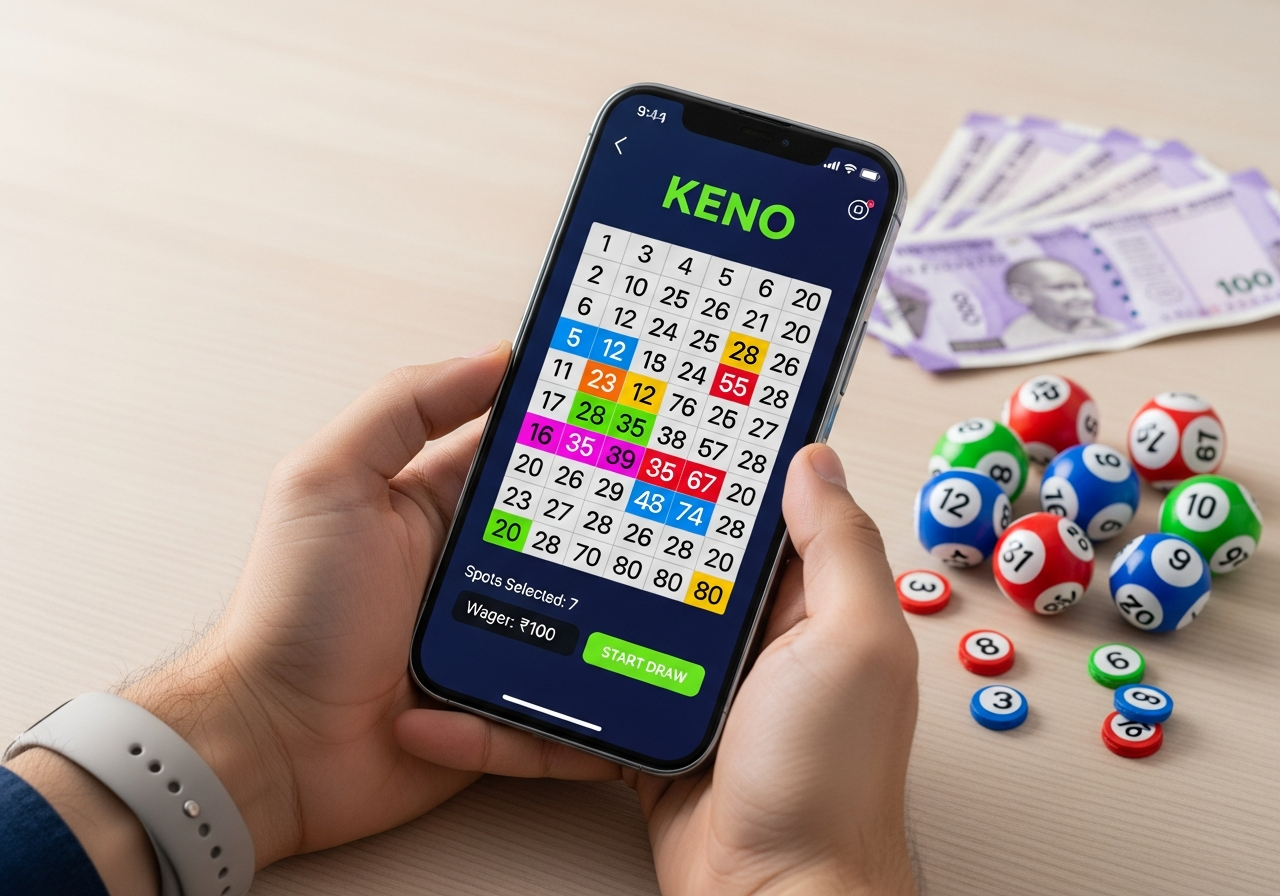
How To Play Online Keno For Real Money
Online keno is a simple, fast-paced lottery-style game that has become increasingly popular among Indian real money players. If you’re familiar with concepts like traditional lotteries, Tambola, or Matka-style number picking, keno offers a regulated casino alternative with fixed paytables and instant results. The game is built on chance rather than skill, making it easy for beginners to understand and enjoy.
This comprehensive guide walks you through everything you need to know about playing online keno for real money in India. We’ll cover how the game works, the legal landscape for Indian players, practical steps to get started, detailed explanations of rules and paytables, strategies for smart bankroll management, and critical information on responsible gambling. Throughout, we’ll focus on India-specific payment methods, regulatory nuances, and realistic stake sizes in Indian rupees. Whether you’re a complete beginner or exploring keno for the first time, this guide provides the depth and practical detail you won’t find in generic online keno articles.
What Is Online Keno And Why It’s Popular With Indian Real Money Players
Keno is a fast lottery-style casino game where you pick numbers from a grid of 1 to 80, and a random draw selects 20 numbers. You win payouts based on how many of your chosen numbers match the draw. The simplicity of the rules, combined with low minimum bets and instant rounds, has made online keno especially appealing to Indian players who want quick entertainment without complex strategies.
Unlike traditional lottery games that draw winners once or twice weekly, online keno delivers results in seconds. Most Indian-facing offshore casinos offer keno with stakes as low as ₹10–₹50 per draw, making it accessible to casual players. The game also aligns naturally with cultural familiarity—many Indians already participate in lotteries or number-based games, so the concept feels intuitive.
It’s crucial to remember from the start that keno is purely a game of chance driven by a random number generator (RNG). No strategy, pattern, or number selection method can overcome the built-in house edge. Keno should be approached strictly as entertainment, never as a way to earn income or recover losses.
How Online Keno Works In Simple Terms
The basic flow of an online keno game is straightforward. First, you select your stake per draw—typically from ₹10 to ₹1,000 or higher, depending on the casino. Next, you pick between 1 and 20 numbers (called “spots”) from the 80-number grid. After confirming your bet, the game’s RNG instantly draws 20 numbers. The game automatically counts how many of your picks match the drawn numbers—these matches are called “catches.” Based on the game’s paytable, your catches determine your payout.
Most Indian-facing casinos offer two main formats. Video keno provides instant RNG draws, allowing you to play multiple rounds per minute if you wish. Live keno, on the other hand, features a host drawing numbered balls on a live stream at scheduled intervals. Video keno suits fast-paced play on mobile, while live keno creates a more social experience similar to traditional lottery draws.
Key Terms You’ll See In Online Keno
Understanding basic keno terminology helps you navigate casino lobbies and paytables confidently. A spot is each number you select on your ticket. The draw is the set of 20 numbers the RNG generates each round. A catch is when one of your spots matches a drawn number. The paytable displays the exact payout for each number of catches at your selected stake level. Your ticket or card is the visual record of your selected numbers and bet. Multi-draw play lets you repeat the same ticket and stake for multiple consecutive draws without re-selecting each time. RTP (Return to Player) is the percentage of all wagered money a game returns to players over time—typical keno RTPs range from 85% to 98%, though specific games vary. Finally, RNG (Random Number Generator) is the certified software ensuring each draw is truly random and fair.
Is It Legal To Play Online Keno For Real Money From India?
India’s gambling laws are fragmented across central and state legislation, creating a complex legal landscape for real money gaming. The Public Gambling Act of 1867 remains the primary federal framework, but it predates modern online gaming and lacks specific clarity on internet-based games like keno. Many states impose additional restrictions on games of pure chance. As a result, the legal status of online keno in India is not entirely settled, and regulations are evolving.
| Aspect | Key Point For Indian Players | Practical Takeaway |
|---|---|---|
| Central Law | Public Gambling Act 1867 is outdated; does not explicitly address online keno | Players cannot rely on old legislation for clarity; check state rules |
| State-Level Variation | Different states have different gambling restrictions; some prohibit all wagering, others allow specific games | Your state of residence matters; verify local rules before playing |
| Licensed Offshore Casinos | Most Indian players use casinos licensed in Malta, Curacao, or other jurisdictions that accept Indians | Offshore licensure offers player protection via regulated frameworks |
| Player Responsibility | You must be 18+ and personally verify local/state laws before gambling; changes occur regularly | Check current state regulations and casino licensing before depositing |
| KYC & Regulatory Compliance | Reputable offshore casinos implement Know Your Customer (KYC) and AML checks for safety and compliance | Completed KYC protects both you and the operator; required for withdrawals |
| No Guarantees of Enforcement | India does not regulate offshore casinos accepting Indian players, so dispute resolution relies on casino terms | Read terms carefully; choose casinos with transparent policies and good reviews |
| Bonus Risks | Unregulated sites may offer unrealistic bonuses with impossible terms; licensed casinos have transparent T&Cs | Stick to licensed platforms; avoid sites with vague bonus rules |
Most Indian players access keno through licensed offshore casino platforms that operate under jurisdictions like Malta (MGA license), Curacao, or similar. These casinos employ independent RNG testing, implement KYC verification, and maintain player protection mechanisms. However, you remain personally responsible for ensuring your play complies with your state’s current laws. Real-money gaming regulations in India are actively evolving, so always verify the latest guidance before depositing funds.
How Offshore Keno Sites Work For Indian Players
Licensed offshore casinos accept Indian players through dedicated websites and mobile apps that support Indian rupees (INR). These platforms use payment gateways compatible with UPI, NetBanking, RuPay cards, and e-wallets to process deposits and withdrawals in INR. When you register, you’ll complete KYC verification—providing ID, address proof, and sometimes PAN—which protects against fraud and money laundering.
The casino’s RNG software, certified by independent testing bodies, generates all keno draws. This ensures fairness and prevents manipulation. Payouts are determined automatically by the paytable and your catches; there’s no human intervention. Reputable operators display their license, RNG certification, and detailed contact information on their websites. Before depositing, verify the casino’s MGA, Curacao, or equivalent license on the regulator’s official website.
Step-by-Step: How To Start Playing Online Keno For Real Money In India
Getting started with real money online keno involves choosing a safe casino, creating an account, completing verification, depositing funds, and placing your first bet. Follow these steps to begin:
- Research and choose a licensed keno casino – Look for platforms with valid offshore licenses (Malta MGA, Curacao, etc.), positive Indian player reviews, clear keno game libraries, and support for INR payments. Avoid anonymous or unverified sites.
- Visit the casino website or app – Navigate to the registration page. Most casinos offer both web and mobile apps optimized for Indian devices and internet speeds.
- Create your account – Fill in basic details: email, username, password (make it strong), date of birth, and full name. Some casinos ask for phone number at signup; others request it during KYC.
- Complete KYC verification – Upload identity proof (Aadhaar, passport, or driver’s license) and address proof (utility bill or recent bank statement). Some casinos request your PAN. This step is mandatory for withdrawals and usually takes 24–48 hours.
- Set a deposit limit in your account settings – Before depositing, configure responsible gambling tools: deposit limits, session time limits, and loss limits. This enforces your budget from the start.
- Make your first deposit – Choose your preferred payment method (UPI, NetBanking, RuPay card, wallet, or crypto if supported), enter the amount in INR, and confirm. Most deposits process instantly.
- Navigate to the keno lobby and place your first bet – Select a keno game (video or live), choose your spots, set your stake, and confirm. Start with demo/free play if available to familiarize yourself with the UI.
Account Verification, KYC And Age Checks
Reputable offshore casinos require Know Your Customer (KYC) verification to comply with anti-money laundering (AML) regulations and prevent fraud. During KYC, you’ll provide government-issued ID (Aadhaar, passport, or driver’s license), proof of address (utility bill, rental agreement, or bank statement), and sometimes your Permanent Account Number (PAN). The casino verifies this information against official databases.
You must be at least 18 years old to play; casinos verify your date of birth during registration. KYC typically completes within 24–48 hours. Importantly, most casinos will not process withdrawals until KYC is fully verified. If your documents are rejected, the casino will notify you; you can then resubmit corrected documents. This process protects you by ensuring your account is secure and your winnings can be withdrawn safely.
Using Indian Payment Methods For Keno Deposits
Indian-facing casinos support multiple deposit methods in INR, making funding your account convenient. UPI (Unified Payments Interface) is the fastest and most popular option for Indian players—deposits typically process within seconds. You’ll see a QR code or UPI ID; open your bank’s UPI app and send the amount. NetBanking allows direct bank transfers; select your bank, log in via your online banking portal, and confirm the transaction.
RuPay, Visa, or Mastercard debit and credit cards are accepted, though some Indian banks flag casino transactions; calling your bank to whitelist the casino domain can help. E-wallets like Paytm, PhonePe, or Google Pay offer quick processing for small amounts. Some casinos also accept cryptocurrencies (Bitcoin, Ethereum, USDT) if you prefer anonymity, though this requires a crypto wallet.
Always use your personal account—never ask friends or family to deposit on your behalf, as this complicates withdrawals and may breach KYC rules. Enable two-factor authentication (2FA) on your bank account and casino account for added security. Deposit confirmation appears instantly or within minutes; if funds don’t reflect, contact casino support with your transaction ID.
Understanding Keno Rules, Tickets And Paytables
Keno’s rules are simple but important to understand fully, especially the relationship between the number of spots you choose and the payouts you can receive. Let’s break down the core rule elements:
| Rule Element | What It Means | Example In An Online Keno Game |
|---|---|---|
| Number Grid | Grid displays numbers 1–80; you select your spots by clicking or tapping them | You click numbers 5, 17, 23, 42, 61, and 78 on the grid to select 6 spots |
| Spots (Selection Count) | The quantity of numbers you pick from the grid; ranges from 1 to 20 | If you pick 6 numbers, you have 6 spots; hitting 4 of them means 4 catches |
| Draw | The RNG generates 20 random numbers from the 1–80 range | The draw might be: 1, 5, 8, 15, 17, 22, 28, 31, 42, 45, 50, 56, 61, 67, 72, 75, 78, 80, 19, 44 |
| Catches (Matches) | Count of your spots that match the drawn numbers | From the example above, you catch 5, 17, 42, 61, and 78 = 4 catches (matches) |
| Stake Per Draw | The amount in INR you wager per single keno round | You bet ₹50 per draw; if you play 10 consecutive draws, total outlay is ₹500 |
| Multi-Draw Play | Select the same ticket (spots + stake) to play across multiple consecutive rounds | You set 5 draws; the same 6 spots and ₹50 stake repeat 5 times automatically |
| Paytable | Chart showing the payout for each number of catches at your stake level | At ₹50 stake, hitting 4 catches might pay ₹200; hitting 6 catches might pay ₹2,000 |
| RTP (Return to Player) | Percentage of all money wagered that the game returns to players over time | Keno RTP typically ranges from 85–98%; higher RTP means slightly better long-term returns for players |
In the online UI, you’ll see the keno ticket as a grid of 80 clickable numbers. Select your spots, choose your stake from a dropdown menu, then decide on the number of draws. Most casinos offer a “Quick Pick” or “Auto Pick” option that randomly selects your spots for you—useful if you prefer not to choose manually. After confirming, the RNG draws 20 numbers, the game counts your catches, and your payout (if any) appears instantly. Different keno games have different paytables; always check the paytable before betting, as it determines your potential returns.
How Keno Payouts And Catches Work In Practice
Let’s walk through a realistic example. Suppose you select 6 spots—say, numbers 7, 14, 23, 35, 48, and 62—and bet ₹50 per draw. The paytable for this game at ₹50 stake shows:
- 3 catches: ₹60 (you win ₹10 more than your stake)
- 4 catches: ₹250
- 5 catches: ₹800
- 6 catches: ₹4,000
The draw results in 20 numbers. You count: numbers 7, 14, and 35 are drawn, but 23, 48, and 62 are not. You hit 3 catches. According to the paytable, your payout is ₹60. You wagered ₹50 and received ₹60, so your net win is ₹10. In another round, you might hit 4 catches, earning ₹250—a ₹200 net gain. Or you might hit 0 or 1 catches and lose your ₹50 stake entirely. This variability is central to keno; each round is independent, and results depend entirely on the RNG draw.
Keno Variants Available To Indian Players
Online casinos offer several keno variants, each with different pacing and volatility. Here’s how the main variants compare:
| Keno Variant | Key Features | Typical Speed & Volatility | Best For |
|---|---|---|---|
| Classic Video Keno | Standard grid (1–80), instant RNG draws, simple paytable, no extras | Fast (instant draws), low–medium volatility | Casual players wanting quick rounds and steady payouts |
| Live Keno (TV-Style) | Live host on video stream, balls drawn in numbered cage, scheduled draw times | Slow (draws every few minutes), low volatility, social feel | Players enjoying social interaction and scheduled entertainment |
| Multi-Card Keno | Play 2–10 tickets simultaneously with different or identical spot selections | Variable speed (depends on draw frequency), medium–high volatility | Experienced players seeking bigger upside from single round |
| Power Play / Multiplier Keno | Built-in multiplier (2x, 3x, 5x) that boosts payouts on certain catch thresholds; costs extra per draw | Instant draws, high volatility (bigger swings) | Risk-tolerant players chasing large single payouts |
| Bonus Ball Keno | Extra bonus ball drawn after main 20; bonus matches award side payouts or multipliers | Instant, medium–high volatility | Players seeking additional win opportunities |
| Turbo Keno | Ultra-fast draws (every 20–30 seconds), simplified paytable, lower stakes | Very fast, high-frequency play, low–medium volatility | High-volume players wanting constant action on mobile |
The core mechanic remains the same across all variants—pick spots, match the draw, get paid by paytable—but each variant suits different preferences and bankrolls.
Live Keno vs Video Keno: Which Suits Indian Players?
Live keno’s main appeal is the experience. A real host draws numbered balls from a cage on video, creating suspense and a social atmosphere similar to traditional lotteries that many Indians enjoy. Live draws occur at scheduled times (often every 5–10 minutes), so there’s natural pacing. However, live keno requires stable internet and longer browser sessions. For Indian players on mobile with limited bandwidth or short breaks, live streams can be unreliable.
Video keno is the opposite: instant RNG draws mean you finish a complete round—selection, draw, payout—in seconds. Video keno is fully optimized for mobile, uses minimal bandwidth, and lets you play dozens of rounds in your lunch break. Video keno suits Indians playing on smartphones, dealing with variable internet quality, or preferring fast-paced entertainment. Start with video keno if you’re new to the game; you’ll understand the mechanics quickly before exploring live formats.
Multiplier And Bonus Feature Keno Games
Power Play and bonus-feature keno games introduce extra winning opportunities, but at a cost. In a Power Play keno game, you might pay ₹75 instead of ₹50 per draw; in exchange, certain catches trigger multipliers (e.g., if you hit 5 catches normally worth ₹800, the multiplier makes it ₹2,400). These variants appeal to players chasing big single payouts, but the higher stake and volatility mean you can burn through your bankroll faster.
Before playing multiplier keno, study the paytable carefully. Understand which catch levels qualify for multipliers and how much extra you’re paying for that feature. For beginners, classic video keno offers a better introduction to the game; experiment with multipliers only after you’re comfortable with standard payouts and bankroll management.
Smart Bankroll Management For Real Money Online Keno
Effective bankroll management is the foundation of responsible and sustainable keno play. It transforms your entertainment budget into a structured plan that prolongs enjoyment and reduces the risk of catastrophic losses. Here are essential bankroll strategies tailored to keno:
- Set a total monthly budget in INR – Decide how much you can afford to lose without impacting rent, bills, education, or savings. This is your entertainment allowance. Many Indian players set budgets between ₹500–₹5,000 monthly; adjust based on your income.
- Divide your budget into session sizes – If your monthly budget is ₹2,000, allocate ₹500 per playing session. This limits losses per session and forces breaks between plays.
- Further divide each session into unit bets – A ₹500 session might allow 20 draws at ₹25 each. If you lose all 20 quickly, your session ends; you don’t rebuy or borrow.
- Set a win target and a loss limit – Decide in advance: “If I win ₹300 (60% of my session budget), I’ll withdraw it and stop.” Likewise, “If I lose ₹500, I’ll stop immediately, even if tempted to chase losses.”
- Avoid chasing losses – This is critical. If you’ve played your unit bets and lost, accept it and move on. Never deposit extra money to “recover” losses; this is how recreational play becomes problematic.
- Use casino tools: deposit limits, session timers, loss limits – Reputable casinos let you set daily, weekly, or monthly deposit caps and session-time alerts. Enable these in your account settings before your first session.
- Never borrow or use credit – Gamble only with money you already have. Do not take loans, credit card advances, or money from family to fund keno play.
Setting Realistic Session Budgets And Limits
Let’s create a concrete example for an Indian player. Suppose your monthly entertainment budget for keno is ₹1,500. You decide to play 3 sessions per week, so each session receives ₹375. Within each session, you play at ₹25 per draw, allowing 15 consecutive draws. Your plan might look like this:
- Session Begins: ₹375 allocated, 15 draws at ₹25 each
- Midway (8 draws completed): You’ve spent ₹200 and won ₹150, so your balance is ₹325
- Win target hit: You’re now up ₹150 profit (40% of your initial ₹375 session budget). You withdraw ₹150 immediately and stop playing, content with the win
- Alternatively, if you hit your loss limit: After 12 draws (spending ₹300), you’ve lost steadily. You’ve only 3 draws left, but you decide to stop at ₹300 loss rather than risk the remaining ₹75, respecting your pre-set loss limit
This discipline ensures keno remains entertainment, not financial stress.
Number Selection, Spots And Basic Keno Strategy
Before discussing strategy, it’s essential to understand a fundamental truth: keno is a game of pure chance. No selection method, pattern, or number prediction can overcome the randomness of the RNG or reduce the house edge. Every number 1–80 has an equal probability (1 in 80) of being drawn each round. The outcome is determined by certified RNG software, not skill.
That said, your choice of how many spots to play significantly impacts volatility and win frequency. Here’s what the math shows:
| Strategy Element | What Players Commonly Do | Mathematical Reality / Comment |
|---|---|---|
| Picking 1–3 Spots | Players choose very few numbers to increase hit frequency | You’ll hit catches often (e.g., hitting 2 out of 2 spots occurs ~6% of draws), but payouts are small and house edge remains fixed |
| Picking 4–6 Spots | A balanced middle ground; many casual Indian players choose 5–6 spots | Sweet spot for most players: reasonable hit frequency (~2–3 hits per 10 rounds) and decent payouts; medium volatility |
| Picking 7–10 Spots | Targeting bigger payouts; requires more catches to break even | Win frequency drops (hitting 7 out of 10 is rare), but payouts are larger; higher volatility, longer dry spells |
| Picking 15–20 Spots | Chasing massive jackpots; requires 10+ catches to profit | Extremely low hit frequency (hitting 15+ is nearly impossible); only the rare big win makes it worthwhile; very high volatility |
| Sticking to the Same Numbers | Cultural superstition (like lucky numbers in Indian Matka); players repeat identical spots every draw | RNG has no memory; last round’s results don’t influence next round. Sticking to numbers is purely for fun and has zero mathematical advantage |
| “Hot” or “Cold” Numbers | Choosing numbers drawn frequently recently, or numbers not drawn in a while | Both are fallacies called gambler’s fallacy. Each RNG draw is independent; past results never influence future draws |
| Patterns & Grids | Selecting numbers in lines, corners, or symmetrical patterns on the grid | Patterns are purely psychological. The RNG doesn’t “care” about grid positions; all combinations are equally likely |
The key insight: your spot count affects volatility, not the house edge. Choosing 6 spots vs. 10 spots doesn’t change the long-term house advantage (typically 10–15% depending on paytable). What changes is hit frequency and payout size. Choose a spot count that matches your risk tolerance and budget.
Choosing How Many Spots To Play Per Ticket
For most beginner and casual Indian keno players, starting with 4–6 spots offers the best balance. At 5 spots with a ₹50 stake, you’ll hit 2–3 catches roughly once every 10 draws, giving you frequent small wins to sustain interest. Payouts for 4–5 catches are reasonable—maybe ₹150–₹400 at ₹50 stake—enough to feel rewarding without requiring impossible probabilities.
Avoid extremes early on. Picking just 1 spot means minimal payouts even when you win; it’s monotonous. Picking 15+ spots chasing a jackpot means 50+ draws between any catch worth celebrating. As you gain experience and understand volatility, you can experiment. But for learning, 5 spots at modest stakes (₹25–₹50) is ideal.
Common Number-Picking Habits In India
Many Indian players choose spots based on birthdays, anniversaries, lucky numbers from Matka or numerology, or culturally auspicious digits. These rituals are entirely fine for entertainment—they add a personal touch and fun to the game. However, they have zero impact on your odds. The RNG treats number 7 (considered lucky in many cultures) identically to number 42.
Enjoy your personal rituals, but keep them in perspective: they’re entertainment flavor, not strategy. Never increase your stake or extend your session because you believe certain numbers are “due.” The math is absolute: all numbers are equally likely, every single draw.
How To Choose A Safe Online Keno Casino In India
Selecting the right casino is your most important decision. A licensed, reputable operator ensures fair games, fast payouts, and dispute resolution. Here’s what to look for:
- Valid offshore license – Confirm the casino holds a current license from Malta (MGA), Curacao, or equivalent regulator. Visit the regulator’s official website to verify; don’t trust casino claims alone.
- Independent RNG certification – The casino should display RNG testing certificates from recognized bodies like eCOGRA, iTech Labs, or GLI. These certifications prove draws are random and fair.
- Clear, detailed paytables – Each keno game must display its exact paytable and RTP (Return to Player percentage) before you bet. Avoid casinos hiding this information.
- Transparent Terms & Conditions – T&Cs must clearly explain account rules, deposit/withdrawal processes, bonus terms, and dispute resolution. If T&Cs are vague or buried, move on.
- Strong reputation with Indian players – Check independent reviews on gambling forums and Reddit; look for consistent praise about fast payouts and good customer service. Ignore reviews on the casino’s own website.
- Fast INR payments via UPI and NetBanking – Confirm the casino supports your preferred payment methods and processes deposits/withdrawals in INR. Test withdrawal speed by reading recent player reviews.
- Responsive 24/7 customer support – Contact support before depositing; ask a question and see how quickly they respond. Good casinos reply within minutes via live chat.
- Mobile optimization – The casino should offer a smooth mobile app or responsive website. Indian players often use smartphones; clunky design is a red flag.
- Responsible gambling tools – The casino must provide deposit limits, session timers, self-exclusion, and loss limits. These tools should be easy to access in account settings.
Red flags to avoid:
- Unlicensed or anonymous operators with no company information
- Claims of unbeatable systems or guaranteed wins
- Vague or hidden T&Cs, especially around bonuses or withdrawals
- No responsible gambling tools or self-exclusion options
- Constant aggressive promotions or spam emails
- Negative reviews mentioning delayed payouts or unresponsive support
Comparing Keno Game Libraries And Limits
Different casinos offer different keno lineups. Some have 5–10 keno variants; others have 50+. A larger library gives you more choice, but quality matters more than quantity. Check whether the casino offers the variants you prefer (video keno, live keno, multiplier versions).
Also verify minimum and maximum stakes. If you want to play ₹10 per draw, ensure the casino allows it; some have ₹50 minimums, which is inconvenient for very cautious players. Likewise, if you ever want to stake ₹1,000 per draw, confirm the max is high enough. Finally, check whether the casino offers a demo or free-play mode for each keno game; this lets you understand the UI and paytable without risking real money.
Bonuses, Promotions And Wagering Terms For Keno Players
Casino bonuses can boost your bankroll, but understanding how they apply to keno is crucial. Many bonuses exclude keno or contribute less favorably than other games, so read terms carefully before claiming.
| Bonus Type | How It Works For Keno | Key Terms To Check |
|---|---|---|
| Welcome/Sign-Up Bonus | Typically a match bonus on first deposit (e.g., 100% match up to ₹5,000). Bonus funds can be used on keno, but often contribute only 25–50% toward wagering requirements | Contribution %, wagering multiplier (e.g., 35x), validity period (usually 14–30 days), max bet allowed per draw |
| Reload Bonus | Offered on subsequent deposits (e.g., 50% match). Similar contribution and wagering rules as welcome bonuses | Check if keno qualifies at all; some casinos exclude keno from reload bonuses entirely |
| Cashback | Rebate of a percentage of losses in a session or week (e.g., 5–10% cashback). Very useful for keno since it’s real money returned, not a bonus with wagering | Cashback is credited directly or as bonus with lower wagering; read if it’s automatic or requires opt-in |
| Free Bets / Free Spins (on Keno) | Some casinos offer free draws on specific keno games, credited as bonus funds or free plays | Check if free draws can be used on any keno variant or only specific games; winnings typically subject to wagering |
| VIP / Loyalty Rewards | Earn points per real-money draw; redeem for bonuses, cashback, or free plays | Low-volatility bonus; keno often earns points at 1:1 with slots, making it less rewarding than high-variance games |
Example: You claim a ₹5,000 welcome bonus (100% match on ₹5,000 deposit) with 35x wagering requirement. You must wager ₹175,000 (35 × ₹5,000) before withdrawing. If keno contributes 25%, each ₹50 keno draw counts as ₹12.50 toward the requirement. You’d need 14,000 draws (₹175,000 ÷ ₹12.50) to clear the bonus—at ₹50 per draw, that’s ₹700,000 total wagered. This is often impractical for casual players.
When It Makes Sense To Use Bonuses On Keno
Small, low-wagering bonuses can add value to your keno play. For instance, a ₹500 cashback (5% of losses in a week, no wagering) is always useful—if you lose ₹10,000 in keno, you get ₹500 back. Free bets or free draws with minimal wagering (e.g., 1x or 2x) are also worthwhile.
Avoid large match bonuses with high wagering multipliers and low keno contribution rates. The math almost always works against you. A better approach: claim small or cashback bonuses, ignore big wagering-heavy offers, and focus your play on a sustainable bankroll from your own funds. Bonuses should enhance your experience, not become the focal point of your strategy.
Playing Online Keno Responsibly And Staying Safe
Keno is entertainment, and like all gambling, it carries risks. Responsible play ensures the game remains fun rather than becoming a source of financial or emotional harm. Here are critical safeguards:
- Set strict time and money limits before you play – Decide in advance how long and how much you’ll gamble in a session. Use casino-provided session timers and deposit limits to enforce these boundaries automatically.
- Never chase losses – If you lose your session budget, stop immediately. Losses are final; continuing play in frustration is the fastest way to lose more. Accept variance as normal.
- Treat wins as fortunate windfalls, not income – If you win ₹1,000, celebrate, then withdraw at least half of it to a separate account. Don’t roll it back into keno assuming luck will continue.
- Never borrow, take loans, or use credit – Gambling on borrowed money is a path to severe financial distress. Play only with funds you own and can afford to lose entirely.
- Use casino responsibility tools – Enable deposit limits (daily, weekly, monthly), session timers, loss limits, and self-exclusion. These tools create hard boundaries that even willpower cannot override.
- Maintain privacy and security – Play only on HTTPS-secured websites (check the padlock icon in your browser). Avoid public Wi-Fi for banking or keno play; use your home network or mobile data with 2FA enabled. Never share your OTP, full card numbers, or passwords with anyone.
- Take frequent breaks – Schedule keno play for specific times; don’t play during stressful moments, late nights, or when fatigued. Your judgment is impaired when tired or upset, increasing the risk of poor decisions.
- Know the warning signs of problem gambling and take action early – If any of the signs below describe you, pause keno immediately and seek help.
Warning Signs Of Problem Gambling In Keno
Recognize these red flags before gambling becomes a serious problem:
- Lying or hiding your keno play – Concealing time spent or money wagered on keno from family, friends, or partners is a major warning sign.
- Escalating stakes to feel the same thrill – You need higher and higher bets to get the same excitement; regular ₹25 bets no longer satisfy you.
- Playing to escape stress or negative emotions – You turn to keno when anxious, depressed, or facing problems, using it to numb rather than address issues.
- Inability to stop or reduce play despite wanting to – You tell yourself you’ll play “just one more round,” but session after session, you keep going.
- Borrowing money to gamble or cover losses – You’re asking friends for loans, using credit cards, or considering taking a personal loan to fund keno.
- Relationships or responsibilities are suffering – Your keno habit is causing arguments with family, affecting work performance, or making you neglect children or bills.
- Chasing losses persistently – You’ve lost significant money and are now gambling harder to “win it back,” despite logical awareness this rarely works.
If you recognize these signs in yourself, take action immediately: Use the casino’s self-exclusion feature to lock your account for 30 days or longer. Confide in a trusted friend or family member and ask for accountability. Seek professional help from counselors or support groups specializing in gambling addiction. While India lacks widespread dedicated helplines, international organizations like Gamblers Anonymous (online meetings available) and the National Council on Problem Gambling provide resources and support.
Remember: problem gambling can happen to anyone, regardless of income or intelligence. Seeking help is not weakness; it’s the smart choice.
Online keno offers straightforward entertainment with the potential for quick payouts. By combining a clear understanding of the rules, disciplined bankroll management, careful casino selection, and robust responsible-play habits, you can enjoy keno safely in India. Always prioritize your financial security and emotional well-being over chasing wins. The game will always be available; your health and relationships are irreplaceable.